What Is IPTV in Canada
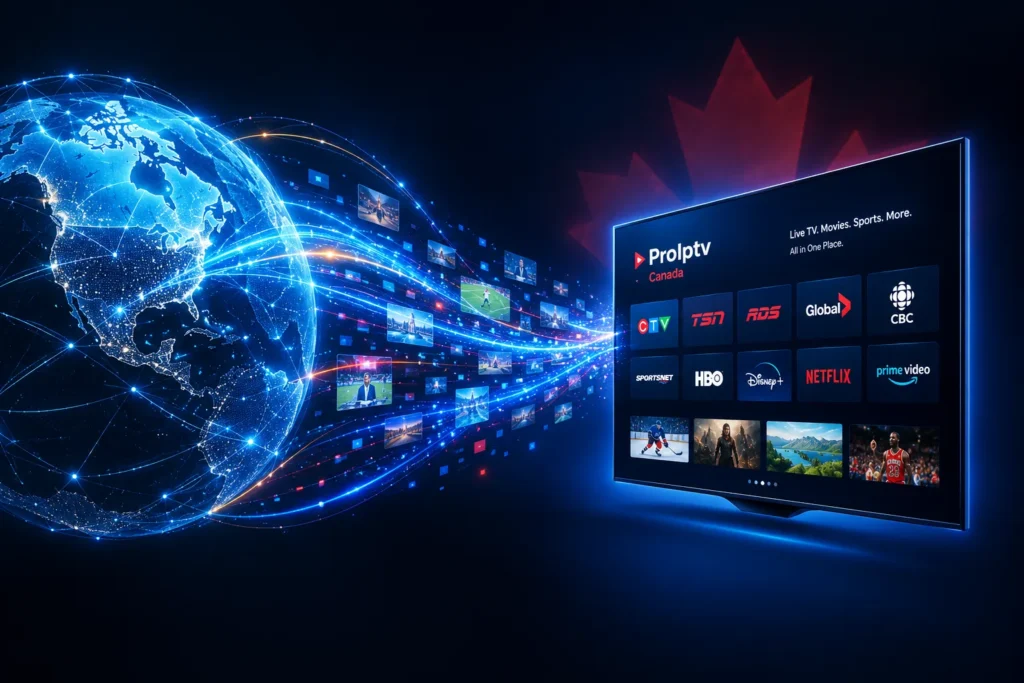
IPTV stands for Internet Protocol Television. Strip away the acronym and it means one simple thing: your television arrives over the same internet connection as everything else in your house, instead of down a coaxial cable or off a dish on the roof.
If you have ever watched anything on a Smart TV app, you have already used the underlying technology. IPTV just applies it to live channels as well as on-demand.
How it differs from cable and satellite
Cable and satellite broadcast everything at once. Every channel is being sent to your house continuously, and your box simply tunes to the one you picked. That is why cable packages are bundled — you are paying for the whole stream whether you watch it or not.
IPTV works the other way round. Nothing is sent until you ask for it. When you select a channel, that specific stream is delivered to your device. This is why it needs no dish, no installer and no proprietary box — and why the channel count can be far larger without your bill growing to match.
What you need
- An internet connection. Roughly 10 Mbps handles HD, and 25 Mbps or more gives comfortable 4K. Almost every Canadian plan clears this easily.
- A device. A Firestick, Android TV box, Smart TV, phone, tablet, laptop, MAG or Formuler — most households already own something suitable.
- A player app. TiviMate, IPTV Smarters, or any Xtream-compatible player.
- A subscription. Which supplies the credentials the app uses.
That is the entire setup. There is no truck roll and no two-year agreement.
Stability matters more than speed
This is the single most useful thing to understand about IPTV, and the thing most people get wrong.
Because live television has to arrive continuously and in order, a connection that drops briefly is far more damaging than one that is merely slow. A rock-steady 30 Mbps line will outperform a 1.5 Gbps connection that stutters — which is why the most common cause of buffering is not your internet plan at all, but the Wi-Fi hop between your router and your TV.
If a stream misbehaves, plugging the TV in with an ethernet cable resolves it more often than any speed upgrade. In older Canadian housing stock — plaster-and-lath walls, finished basements, brick — this is especially true.
What IPTV is good at
- Breadth. International and community channels that Canadian cable packages have historically served poorly, or charged a premium add-on for.
- Flexibility. It travels. The same subscription works on a laptop in a hotel as it does on the living room TV.
- Catch-up. Most services keep several days of programming, which genuinely matters if you live in Pacific or Atlantic time and games land at awkward hours.
- Cost. One subscription typically replaces a cable package plus two or three streaming services.
And what it is not
IPTV depends entirely on your internet. If your connection goes down, so does your television — there is no separate cable feed to fall back on. Households in areas with unreliable service should weigh that honestly.
It is also worth understanding that an IPTV provider and the content it carries are separate things. Providers deliver streams sourced from third parties; they are not broadcasters. Whether any given content is licensed for viewing where you live is a question worth asking, and the answer varies. Our Disclaimer sets out our position plainly.
Try it rather than read about it
No article can tell you how a service will behave on your particular connection, in your particular building, at 8pm on a Saturday. That is what a free trial is for — test a live game at peak hours on the TV you would actually use, and you will know within twenty minutes.
More questions? The FAQ covers setup, devices and payment.