IPTV vs Cable in Canada
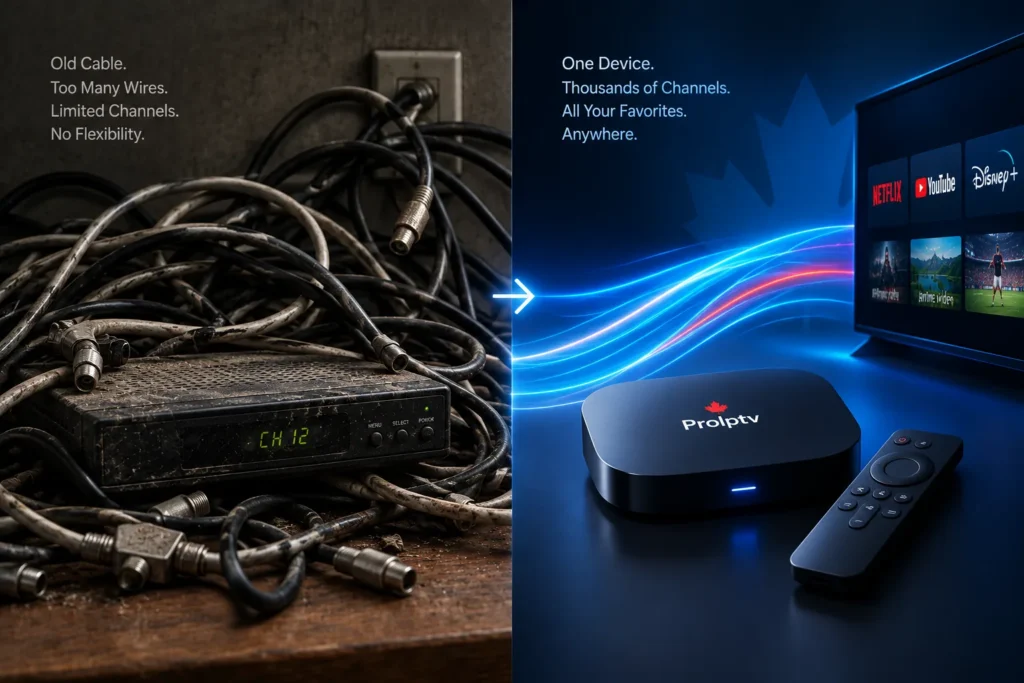
Canadian television is expensive by international standards, and most households know it. What is less obvious is what you actually lose by leaving cable — so here is a straight comparison rather than a sales pitch.
Cost
A typical Canadian cable package sits well north of $80 a month once equipment rental, HD fees and the inevitable post-promotion increase are included. Add a couple of streaming subscriptions on top — because the cable package does not carry everything either — and many households are past $150.
IPTV is typically a fraction of that, paid once for a fixed term rather than monthly and indefinitely. The saving is real, and it is the main reason most people switch.
Worth checking honestly: if your TV is bundled with internet and phone, cancelling the TV portion sometimes raises the price of the other two. Look at the bundled total, not the TV line item.
Equipment and installation
Cable means a box per television, usually rented monthly, plus an installer appointment and often a dish or a wall drill. Satellite adds weather to the list of things that can interrupt your evening — anyone who has watched a signal die during a January storm in Edmonton or a nor’easter in Halifax knows this.
IPTV needs no new hardware if you already own a Firestick, Smart TV or Android box, and nothing outdoors to misalign or ice over.
Contracts
This is the difference people underestimate. Cable is built around retention: term commitments, cancellation fees, promotional rates that quietly expire, and a phone call with a retentions department when you try to leave.
A fixed-term IPTV subscription simply ends. There is nothing to cancel and no conversation to have.
Channel choice
Canadian cable is structured around tiers and themed bundles. If you want one channel that sits in a higher tier, you buy the tier. International and community programming has always been the weakest part of that model, usually sold as a costly add-on with a thin selection.
This is where IPTV is genuinely stronger, and it is why uptake has been fastest in the most diverse parts of the country — Scarborough, Surrey, Saint-Léonard, north Winnipeg.
Where cable still wins
An honest comparison has to include this.
- It does not depend on your internet. If your connection is unreliable, cable keeps working when streaming would not.
- It is simpler for some households. One remote, one box, nothing to configure. That has real value.
- Local channels are straightforward. Over-the-air local stations are baked in.
- A single accountable provider. One company to call, and a regulated complaints process behind it.
If your internet is patchy, or nobody in the house wants to think about apps, cable may genuinely be the better fit. We would rather say that than sell you something that frustrates you.
The comparison at a glance
- Monthly cost — IPTV considerably lower
- Contract — cable ties you in, IPTV does not
- Equipment — cable rents you a box, IPTV uses what you own
- International channels — IPTV far stronger
- Works without internet — cable only
- Setup effort — cable easier for the non-technical
- Travels with you — IPTV only
Test before you cancel anything
The sensible order is: run an IPTV free trial alongside your existing cable for a week, watch a live game at peak hours on the TV you actually use, and only then decide. If it holds up, cancel with confidence. If it does not, you have lost nothing.
See pricing or read what IPTV actually is first.